The beautiful and airy concepts of space and time
The SilenceThe beautiful and airy concepts of space and time is a phrase from a footnote in Einstein’s 1912 Manuscript on the Special Theory of Relativity that returns in conversation as both a remembered citation and a repeated verbal fragment. Its significance lies in the contrast between the expansive ideas of space and time and the scene’s more immediate uncertainty about science, technology, and the world connecting people across distance.
Source and Recollection
The phrase is introduced as a footnote from the manuscript, not as a newly formulated idea. The speaker admits that it is “not smart exactly” but keeps repeating it, making recurrence part of its meaning: the line has remained memorable even when its speaker cannot present it as an argument or a clever remark. Its formal origin in a footnote also matters. The remembered words come from the marginal apparatus of a scientific text, the sort of detail that can be overlooked but, for this speaker, persists.
The exchange leaves the language of the phrase unsettled. Asked whether the footnote is in English or German, the speaker answers that it depends. The conversation then reduces the phrase to “Space and time,” before extending it to “Space and time. Spacetime.” The movement from a full, airy formulation to a compact technical term shows the words being handled in several registers: as a quotation, as two elementary concepts, and as a joined scientific idea.
Classroom Use and Scientific Language
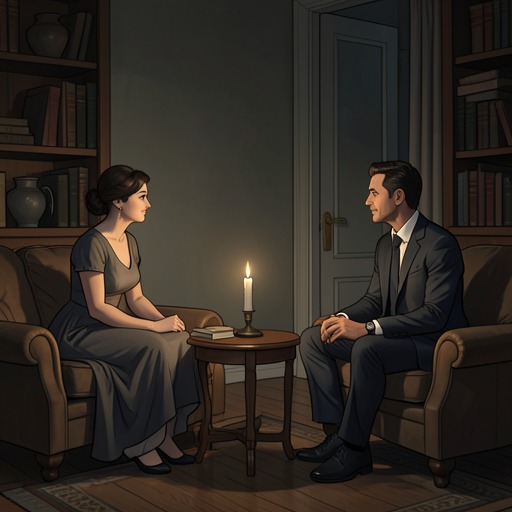
The phrase opens onto a recollection of classroom habits. The speaker is told that, in class, footnotes were quoted and the speaker seemed to vanish into them, citing Einstein, Heisenberg, and Gödel alongside relativity, uncertainty, and incompleteness. This account presents scientific language not only as knowledge but as a familiar mode of attention—one that could draw the speaker away from the immediate room and into the accumulated texts and concepts of science.
That remembered absorption is set against a present attempt to imagine the many rooms and cities where a game is being broadcast. The imagined audience includes people watching intently and people sitting in confusion, “abandoned by science, technology, common sense.” The phrase’s large conceptual reach therefore meets a dispersed human scene: space is not merely an abstraction when people are pictured in separate rooms and cities, while shared access to technology does not guarantee that the world makes sense to them.
Repetition Against Disconnection
The expression’s recurrence gives the exchange a small but clear structure. It begins as a footnote, becomes something the speaker admits to repeating, is restated as “Space and time,” and then arrives at “Spacetime.” Each return compresses the language without resolving the uncertainty around it. The phrase continues to be available, but its beauty does not itself restore confidence in scientific or technological understanding.
Immediately after imagining the scattered audience, the speaker borrows Martin Dekker’s phone to try to call two daughters, one in Boston and the other somewhere in Europe. The attempts produce no response from the device. This adjacent failure makes the contrast between conceptual and practical distance especially concrete: the conversation can imagine people across cities, but the effort to reach family by phone does not succeed. The phrase endures as an evocative piece of scientific language amid that gap between the world people can picture and the connections they can actually make.